How to Play Whist: The Card Game That Ran the Regency Drawing Room
By Emma · August 16, 2026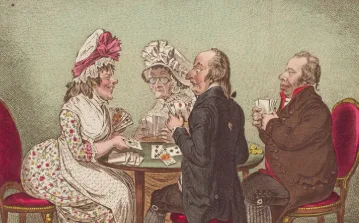
Long before anyone was worrying over eligible bachelors or entailed estates, a Regency evening still had to be filled with something between dinner and bed. More often than not, that something was whist. It was, by a wide margin, the most popular card game in England at the time. Easy enough to learn in an evening, and absorbing enough to occupy a room full of people who'd already exhausted the topic of the weather.
Even Mr. Collins Had to Learn the Rules
In the 1995 adaptation, Mrs. Philips invites Mr. Collins to sit down for a hand of whist during her card party, and it turns out he doesn't actually know how to play. It's a very Collins moment. He's spent his entire visit performing a confidence he doesn't quite have, and whist turns out to be the one thing in the room he can't talk his way through. If you'd be in the same spot he was, there's no shame in it. Here's what somebody should have told him before he sat down.
Whist at Hartfield
Whist plays a much gentler, more domestic role in Emma. Mr. Woodhouse, constitutionally incapable of enjoying much of anything that involves leaving the house, is at his most content when a card table can be assembled. Whist works like a coping mechanism for him, a small, controlled activity with rules he can count on, in a world he otherwise finds alarming.
Emma gives us a whist club as an established institution in Highbury too, regular enough that missing it is notable. When Mr. Elton unexpectedly leaves for London rather than attend, it doesn't go unremarked. It's whist club night, and by every account, he's never missed one before. That's whist doing real narrative work. It functions as a piece of social clockwork, reliable enough that its disruption becomes a clue something is off before anyone says so directly.
How to Actually Play
The rules haven't changed much since Mr. Woodhouse's day, and the game itself is genuinely easy to pick up.
What you need: 4 players, split into two partnerships, with partners seated across from each other, and a standard 52-card deck with no jokers.
The deal: The entire deck gets dealt out, one card at a time, so each player ends up with 13 cards. Traditionally, the dealer's own last card gets turned face up to reveal the trump suit for that hand. It stays exposed on the table until the dealer's first turn to play, then joins the rest of the hand.
Playing a trick: The player to the dealer's left leads the first trick by playing any card. Play moves clockwise, and everyone else has to follow suit if they can, meaning they play a card of the same suit that was led. If a player has no card in that suit, they're free to play anything, including a trump.
Winning a trick: Whoever plays the highest card of the suit that was led wins the trick, unless someone plays a trump. Then the highest trump wins instead, even if it's ranked lower than the cards in the original suit. The winner of each trick leads the next one.
Scoring: Play continues until all 13 tricks are taken. The first 6 tricks a partnership wins together don't count for anything. They're called the book. Every trick beyond that scores one point for that partnership. A full game was traditionally played to 10 points, what's known as Long Whist, the standard through Austen's own lifetime. The shorter 5-point version, Short Whist, didn't become fashionable until decades later. A "rubber," the largest unit of play, is the best of 3 games.
Strategy, briefly: Whist rewards paying attention to what's already been played more than any complicated bidding system, mostly because there isn't one. That came later, with Bridge, which whist eventually gave rise to. Counting cards within a suit, remembering what your partner has signaled through their play, and holding back strong cards until the right trick come up are the basics that separate a good player from a lucky one.
Try It Yourself
Reading the rules only gets you so far. Take a seat at the table, across from a partner of your choosing and directly opposite Mr. William Collins himself, endlessly pleased with his own company, and play a full hand of Regency whist against him and two other Pride and Prejudice characters right now.
Play Whist With Mr. Collins →Don't Miss the Next One
New essays and travel guides don't run on a schedule, they go up when there's actually something worth saying. Subscribe and I'll let you know the moment one does.
Subscribe to the Newsletter →