My Initial Defense of Caroline Bingley
By Emma · September 6, 2026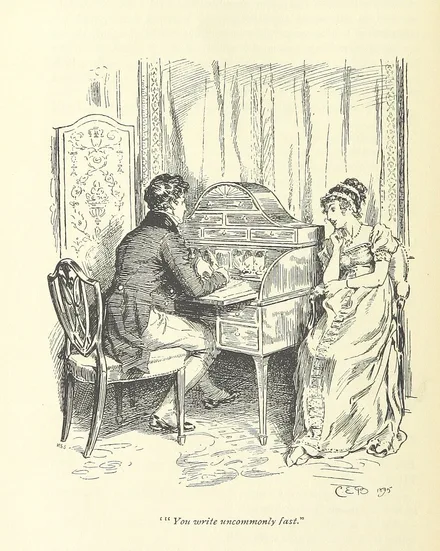
Caroline Bingley spends most of Pride and Prejudice trying to get Mr. Darcy's attention by any means necessary, and Chapter 10 might be her most transparent attempt at it. He's writing a letter to his sister. She's watching him do it, uninvited, and eventually says, "You write uncommonly fast." It isn't really a compliment, it's a bid for his attention routed through his handwriting, and Darcy, unmoved, corrects her, he writes rather slowly. Elizabeth, doing needlework across the room, watches the whole performance and isn't fooled for a second.
Neither, honestly, am I. But I don't think that makes Caroline the villain everyone's decided she is. I think she might be the sharpest, most honest person in the entire novel, and the way we've collectively decided to read her says more about what we expect from ambitious women in stories than it does about anything Austen actually put on the page.
The Only Character Who Says the Quiet Part Out Loud
Nearly everyone in this novel is playing the same game, marry well, secure status, avoid financial ruin, and almost every other character has the social grace to pretend they aren't doing it. Charlotte Lucas marries Mr. Collins and the narrative treats it as sensible resignation. Mrs. Bennet spends the whole book maneuvering her daughters toward wealthy men and gets mocked for how obvious she is about it, not for wanting it in the first place. Even Elizabeth, our supposed romantic idealist, ends up married to a man with 10 thousand a year, and nobody calls that opportunism.
Caroline gets disliked for wanting exactly what everyone else wants, minus the performance of pretending she doesn't. She's direct about her ambitions in a novel built almost entirely on people being indirect about theirs. That directness reads as cold. I think it's closer to honest, in a world that never actually rewarded honesty like that.
The Speech That's Doing More Work Than It Gets Credit For
Caroline's most quoted moment happens in Chapter 8, when she lists off what it actually takes to be considered an accomplished woman. "A woman must have a thorough knowledge of music, singing, drawing, dancing, and the modern languages, to deserve the word; and besides all this, she must possess a certain something in her air and manner of walking, the tone of her voice, her address and expressions, or the word will be but half-deserved." Darcy adds his own requirement, the improvement of her mind by extensive reading, and Elizabeth, listening to this impossible checklist assembled in real time, tells him she's "no longer surprised at your knowing only six accomplished women. I rather wonder now at your knowing any."
It's usually read as Caroline showing off, and it is that. But it's also the single most quoted description of what Regency society actually demanded of women anywhere in the novel, precise enough that I built an entire game out of it. That speech is the reason the Accomplished Young Lady lessons on this site exist at all, music, French, deportment, the whole impossible curriculum, lifted more or less directly from Caroline's own words. She wasn't inventing an absurd standard to make herself look good. She was reciting the actual rules, and reciting them accurately is exactly why the moment stuck around for 2 centuries.
She Is, Genuinely, Funny
It's worth saying plainly, Caroline gets some of the best lines in the book. That letter-writing scene from the top of this piece is a good example, the exaggerated praise of Darcy's handwriting, the interruptions to send compliments to a sister she barely knows, the increasingly transparent bids for his attention while he keeps writing without looking up. Austen gave her wit sharp enough to rival Elizabeth's own, just aimed in a less sympathetic direction. Flat villains don't get scenes this specific, or this well-observed. Caroline gets them because Austen clearly enjoyed writing her.
The Class Anxiety Nobody Wants to Talk About
Caroline's snobbery toward the Bennets isn't really about the Bennets. Austen tells us plainly where it actually comes from, the Bingley sisters had 20 thousand pounds each, had been educated at one of the best private seminaries in London, and were, in Austen's own narration, "entitled to think well of themselves, and meanly of others," a fact "more deeply impressed on their memories than that their brother's fortune and their own had been acquired by trade." That isn't subtext I'm reading into the book. That's the narrator saying it outright. Caroline's contempt for anyone with lower connections isn't confidence, it's overcorrection, the specific, brittle snobbery of someone whose own social position is one generation newer than she'd like anyone to notice. That doesn't excuse how she treats people. It's a more interesting explanation than simply mean.
I made a version of this same argument when I wrote about what the 2005 film loses by writing the Hursts out of the story almost entirely. Caroline's meanness reads as an individual failing once you remove her sister from the picture, when the novel is pretty clearly showing you a family habit instead of one bad personality.
What We're Really Objecting To
I think the actual reason Caroline gets remembered as a villain instead of a fully realized, sympathetic-if-unpleasant character comes down to this. She wants Darcy openly, pursues him visibly, and fails. Elizabeth wants nothing, performs indifference perfectly, and succeeds. The novel, and 2 centuries of readers since, reward the woman who plays hard to get and mock the woman who just tries. That's a very old story about which kinds of female ambition get forgiven and which get laughed at, and Caroline's been absorbing that judgment for 200 years for the crime of wanting something in front of everyone and not getting it.
I don't think Caroline Bingley is a good person. I think she's sharp, funny, anxious, and ambitious, operating by the exact same rules as everyone else in this novel, just without the plausible deniability the more likable characters got to keep. That's worth defending, even if I still wouldn't want to sit next to her at dinner.
Consider this the initial defense. I have more to say about Caroline Bingley, and I suspect I'll be saying quite a bit more of it before too long.
Don't Miss the Next One
New essays and travel guides don't run on a schedule, they go up when there's actually something worth saying. Subscribe and I'll let you know the moment one does.
Subscribe to the Newsletter →Take Caroline's Own Advice
Music, French, deportment, and the rest of the impossible checklist from Chapter 8, now a real set of lessons. See how accomplished you actually turn out to be.
Try the Accomplished Young Lady →