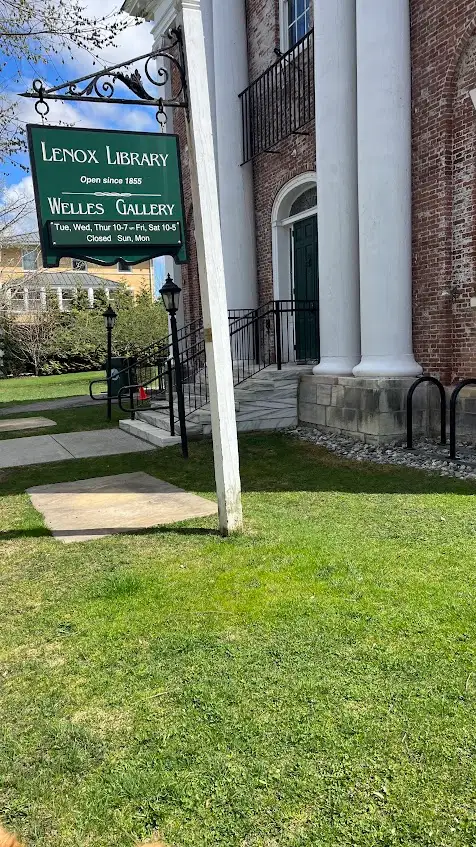
The Lenox Library, in the brick building that served as the Berkshire County courthouse until 1868. When the county business moved to Pittsfield, the town kept the courthouse and filled it with books. The sign still says open since 1855.
A small Berkshires hill town that spent a century as a summer stage for writers, Gilded Age fortunes, and the Boston Symphony, and still runs on all three.
Last Updated: August 29, 2026
Lenox sits in the hills of far western Massachusetts, about ten minutes off the Massachusetts Turnpike and almost exactly halfway between Boston and New York. There is no train into town. Amtrak's Lake Shore Limited stops once a day in Pittsfield, ten minutes north, and buses run from New York and Boston to the village. The times below are for driving.
Lenox was incorporated in 1767 and named for Charles Lennox, the Duke of Richmond, a man in the House of Lords who had taken the colonists' side in the arguments that led to the Revolution. For its first century it was a working hill town, and for eighty one of those years it was the seat of Berkshire County. The courthouse went up in 1815, the county's business ran through it until 1868, and then the honor and the traffic moved north to Pittsfield. The building is still on Main Street. It has housed the Lenox Library since the 1870s, and the library association itself has been lending books in town since 1855.
Losing the county seat could have been the end of the story. Instead the writers arrived. Catharine Sedgwick, one of the most widely read American novelists of the 1820s and 1830s, kept her family's house here, a place everyone called the Hive, and filled it with visitors. Nathaniel Hawthorne rented a small red farmhouse near the Stockbridge line in 1850 and wrote The House of the Seven Gables in it. Herman Melville, just over the hill in Pittsfield, would ride down to call. Fanny Kemble, the English actress, bought property and lent the town a certain theatrical glamour.
By the time the railroad reached the Berkshires, Lenox had a settled reputation as the place where interesting people spent the summer. Everything the next hundred years built here was built on that.
In the last decades of the 1800s the summer people stopped renting and started building. The families with the new industrial fortunes, the Morgans and the Westinghouses and their circle, put up enormous houses here and called them cottages, which fooled no one. For a stretch around 1900 the papers called Lenox the inland Newport, and it earned the comparison. Something like seventy five of those cottages still stand in and around town. A few are open to walk through. Ventfort Hall, the brick Jacobean pile that J.P. Morgan's sister Sarah built in 1893, runs tours and a small Gilded Age museum. The grandest of them all, a place called Shadowbrook, burned long ago.
The federal income tax and then the Depression ended the cottage era. The houses became schools, religious retreats, hotels, or ruins. What kept Lenox from simply fading was culture. In 1937 the Boston Symphony Orchestra made the Tanglewood estate, right on the Lenox and Stockbridge line, its summer home, and it has played there every summer since. Shakespeare and Company started staging plays in town in 1978, first on the grounds of The Mount. Edith Wharton's estate itself went from near ruin to a restored house museum over those same decades. The town now runs on concerts and writers' houses the way it once ran on court dates and railroad money.
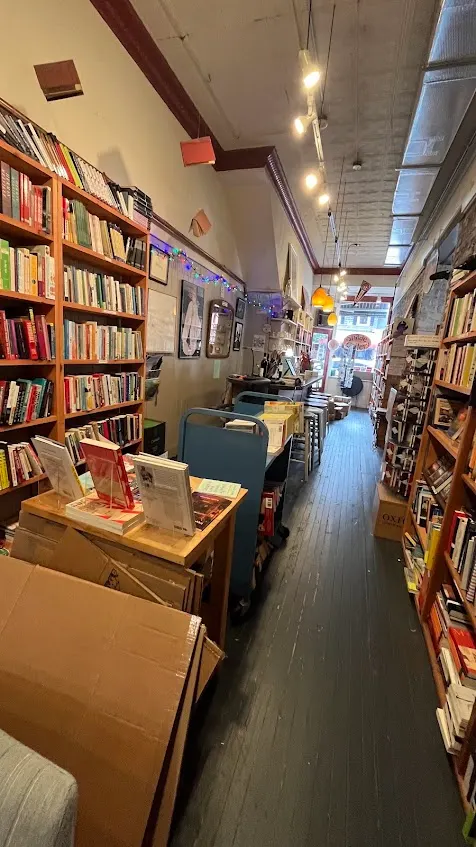
The reason I first drove out to Lenox was a film. Hello, Bookstore came out in 2022, shot almost entirely inside one shop on Housatonic Street through the strange pandemic months, and it is really a portrait of the man who runs the place. The shop is called, with no further ceremony, the Bookstore. Matt Tannenbaum has owned it since 1976 and has the manner of someone who has read the back catalogue and remembers most of it. The shelves are deep and a little overgrown and arranged by a logic that rewards slow browsing.
In 2010 he opened a small wine bar in the next room and named it Get Lit. You can sit with a glass among the poetry section on a weekend afternoon, which is exactly the sort of thing I will happily drive two and a half hours for.

I cannot pass through the Berkshires without making at least one literary house call, and the one I recommend is a short drive north into Pittsfield. Arrowhead is the yellow clapboard farmhouse where Herman Melville lived from 1850 to 1863. He wrote Moby-Dick here, at a desk on the second floor, looking out a north window at the long grey back of Mount Greylock. He thought the ridge looked like a whale.
He and Hawthorne had met that same summer on a group hike up Monument Mountain, caught in a thunderstorm, and the friendship that came out of it is part of why the novel exists. Arrowhead is a museum now, run by the Berkshire County Historical Society, and the study and the view are both still there. Pay your respects to the great cranky novelist, then drive back down to Lenox and its softer, more upholstered version of the same century.
Summer is Tanglewood season, roughly late June through Labor Day, and it is when the town is fullest, priciest, and most itself. If you want a lawn ticket and a picnic on a warm night with the Boston Symphony drifting out of the shed, come then and book everything early. I tend to prefer the shoulders. Late September and the first half of October turn the hills every shade the foliage brochures promise, the cottages look their best against it, and The Mount and Arrowhead are both still open.
May is quiet and green and cheap, with the gardens coming back and the summer crowd still a month off. Winter is for people who want the town nearly to themselves, a fire, and a tall stack of something bought from the Bookstore.

The village is small enough to cover on foot in twenty minutes, and it feeds people well. My first stop most mornings is Patisserie Lenox on Church Street, for an almond croissant and a coffee at one of the sidewalk tables while the town wakes up. Nudel, a few doors along, has run a short, changing New American menu out of a tiny room since 2009 and does not take reservations, so go early or wait.
Bistro Zinc, in the blue building on Church Street, is the place for a proper French dinner, steak frites and a long wine list and a room that hums. Haven, up toward the library, is where I go for a slow weekend brunch before a museum.
The bottom line: Lenox is a small mountain town that has spent two hundred years serving as a stage for people who came up from the city to read, listen, and watch one another. That is still what it does best. Come for a Tanglewood weekend or an October drive, walk the village, tour one cottage, and give an afternoon to a writer's house.
The essentials, at a glance.
The Lenox Library, in the brick building that served as the Berkshire County courthouse until 1868. When the county business moved to Pittsfield, the town kept the courthouse and filled it with books. The sign still says open since 1855.
The view north from Arrowhead toward Mount Greylock, a short drive from Lenox in Pittsfield. This is roughly what Melville saw from his study window while he wrote Moby-Dick. He was convinced the ridge looked like a whale, and on a grey afternoon he has a point.
Breakfast at a sidewalk table on Church Street, from Patisserie Lenox across the way. This is how I start most days in town, before the shops open and the Tanglewood traffic builds.
Lenox in its cottage years worked exactly the way the resort towns work in Austen. Bath, in Northanger Abbey and Persuasion, is a place people travel to in order to be seen, to walk the same few streets at the same hours, to take the waters as cover for the real business of noticing who bows to whom. Gilded Age Lenox was that with a mountain view. The families came up for a fixed season, built houses whose only real purpose was entertaining, and spent the months calling on one another and keeping a precise private ledger of rank and income. Sanditon, the novel Austen left unfinished, follows a man trying to will a plain seaside village into a fashionable resort by sheer promotion. Lenox is what that scheme looks like once it works, and then keeps working for fifty years.
The second thread is more direct, and it is standing on a hill at the edge of town. Edith Wharton designed The Mount in 1902 and wrote The House of Mirth there, the novel that puts Lily Bart, a woman with charm and taste and no fortune of her own, into a marriage market that closes one door after another on her. Critics have called Wharton the American heir to Austen for good reason. She writes the same comedy of manners with the same cold eye, and the same understanding that for a woman without money the drawing room is where a life is won or lost. To walk Wharton's gardens and her library and then read the book she wrote in that house is about the closest thing this country has to a visit to Chawton. For more of this, I keep a running list of Austen settings and their Northeast doubles.
Newport, Rhode Island is the town Lenox was nicknamed after, the same fortunes and the same summer season played out in marble on a cliff above the Atlantic instead of in shingle and brick in the hills. For a quieter single afternoon of the same era, Glen Foerd is a Gilded Age estate on the Delaware that Philadelphia mostly keeps to itself.
If Arrowhead and The Mount give you a taste for writers' houses, Concord, Massachusetts has four of them inside a twenty minute walk, including Orchard House, where Louisa May Alcott wrote Little Women. And Nantucket is the island the Pequod sails from in the novel Melville wrote at that desk in Pittsfield, still looking much as it did when whaling money built it. Three hours north, Stowe, Vermont is the Green Mountain version of a Berkshires summer, and I took Mansfield Park to the top of Mount Mansfield there for reasons that were entirely about the name.
Don't Miss the Next One
New essays and travel guides don't run on a schedule, they go up when there's actually something worth saying. Subscribe and I'll let you know the moment one does.
Subscribe to the Newsletter →About 130 miles, or 2 hours 30 minutes straight west on the Massachusetts Turnpike. The nearest train is Amtrak's Lake Shore Limited, which stops once a day at Pittsfield, about ten minutes north of Lenox.
About 140 miles, or close to 3 hours by car, most of it up the Taconic State Parkway. There is no direct train to Lenox, though bus service runs from New York to the center of town.
Lenox is best known as the home of Tanglewood, the Boston Symphony Orchestra's summer festival, and as the town where Edith Wharton built and wrote at her estate, The Mount. It is also the site of dozens of surviving Gilded Age mansions and the anchor town of the cultural Berkshires.
Yes. Edith Wharton designed the house and its gardens in 1902 and wrote The House of Mirth there. The house and grounds are open for guided and self-guided tours from spring through fall, and the gardens alone are worth the admission.
Yes. The village center is small and walkable, but Tanglewood, The Mount, Arrowhead, and the Gilded Age cottages are spread across several miles with little public transit between them, so a car makes the visit work.
Quite a lot. Tour The Mount or Ventfort Hall, drive to Herman Melville's Arrowhead in nearby Pittsfield, browse the Bookstore and its Get Lit wine bar, walk the trails at Kennedy Park, and come in early October for the Berkshires foliage.
Pin this guide for your next trip to the Berkshires!
Pin ItNot seeing a pin ready to save? Follow along for more here: Emma Shorebreak's Northeast Travel board on Pinterest
More of the Berkshires, and wherever the next drive takes me, over on Instagram.
Follow @emmashorebreak →